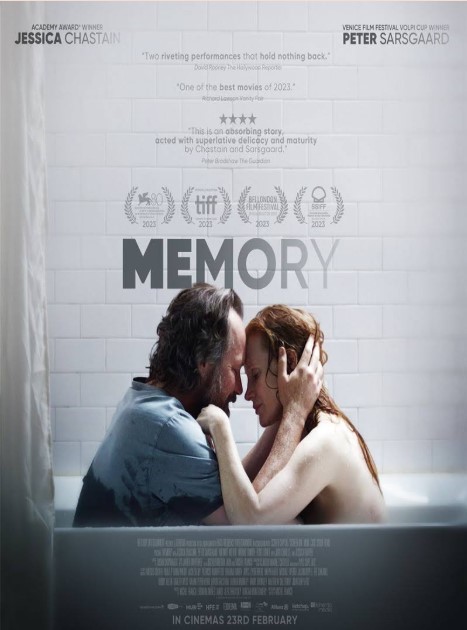
I wanted to watch something Latin American, and when I stumbled upon Memory (2023), directed by Michel Franco, the fact that it was an independent feature film felt like the ultimate cherry on top. Plus, it stars Jessica Chastain. I went into this movie genuinely excited.
Unfortunately, just 30 minutes in, I found myself fast-forwarding through a lot of it.
I can’t even say it is because Memory has a bad story. It is because the film promised a raw, honest look at PTSD healing and trauma recovery, but somehow delivered a romantic comedy instead.
The Bait-and-Switch: PTSD Healing or Romcom? I can’t say the movie was bad because of the story, but rather because I was promised a narrative about PTSD healing and somehow got a romcom. I wanted to see how Jessica Chastain’s character, Sylvia, actually heals. I wanted to see how the people around her react to her pain. At first, when she confronted Saul (Peter Sarsgaard), I was like “Yes! Finally, some conflict.” But the momentum completely died.
I am left with so many questions that I feel the script didn’t bother to answer. Wasn’t she in the same neighborhood she grew up in? Did she ever see the real perpetrators? Sylvia is a social worker who lives, works, and raises her daughter in the same neighborhood where she grew up. Her sister lives nearby, and her mother still resides in their childhood orbit. In a realistic indie drama about a small, tight-knit community, a survivor walking the same streets would inevitably run into, see, or actively avoid the men who harmed her—especially since they were peers from the local school system. The script completely ignores this reality. I needed more scenes to understand the family dynamics, such as why the big sister was still in contact with the mother.
The Underdeveloped Male Lead: Peter Sarsgaard is a fantastic actor, but his side of the story was severely underdeveloped. For someone with dementia, I did not understand how he was falling in love or being the “anchor” for this broken woman. It just didn’t make sense. Why was his card cut off? I needed to understand his dementia. How advanced was his dementia? How much did he actually remember? What exactly were the limitations of his condition? But this was not properly built.
The Family Dynamics: Plot Holes Galore; as a writer, I just could not stop watching the script. I realized halfway through that I wasn’t even watching Memory as an audience member anymore. I was watching it like a writer. Every unanswered question made me think about story structure, character development, and narrative choices. In that sense, the movie actually became a learning experience. I look for the “why.” Why was the mother in denial? Who was the father of Sylvia? Did Julie know that her sister knew what was happening to her? And what about the next generation? Was Sylvia’s kid not affected at all by her strictness? Children usually absorb far more than adults realize.
I Didn’t Need the Romance; This might be my biggest criticism. I just think the sensual relationship between Sylvia and Saul was unnecessary. Maybe this could have been a beautiful, platonic friendship that served the story better. Picture this: Sylvia finds comfort in Saul’s dementia as a secret keeper, and Saul finds a companion who doesn’t treat him as a sick person. Simple. Powerful. But instead, we got romance.
Final Verdict: Should You Watch It? Honestly, I’m torn. I don’t know how to recommend this one. Maybe this movie is for people who love independent feature films and are die-hard fans of the actress Jessica Chastain. She gives a wonderful performance as a rape victim, as always. For scriptwriters and people who watch movies for the story structure, this is a learning experience—a case study in what happens when you abandon character development for contrived romance. But if you don’t fall under those categories, then this is not for you.