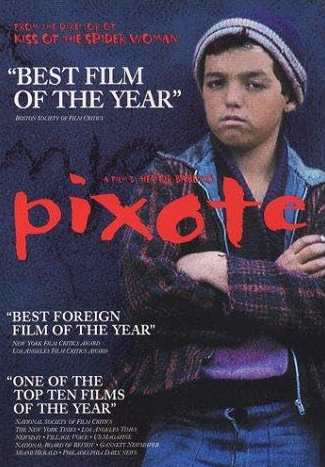
Pixote: A Lei do Mais Fraco (1981), directed by Héctor Babenco, is one of those films that hits you once—and then just stays with you. Written by Babenco and Jorge Durán, this Brazilian classic was restored in 2025, but honestly, it feels like it could have been made yesterday. That’s how little the world has changed in the spaces it exposes. Some movies don’t just tell you a story; they give you a mirror and whisper: this has always been here, and it’s not leaving anytime soon. I watched the 2025 restoration – crystal clear, and yet it feels like it was shot last year. The themes are so painfully current: child crime, juvenile prisons, rape, corrupt police officers, a government that forgets the poor, social imbalances, LGBTQ+ street life, drugs, injustices, and prostitution. This Brazilian classic doesn’t flinch. It can’t afford to.
The Journey of a Boy Who Only Knows the Streets; Pixote, played by Fernando Ramos da Silva, is a 10-year-old homeless boy thrown into the savage world of a juvenile reformatory. He’s already been shaped by the streets. He doesn’t dream of school or a better life, not because he doesn’t want to, but because life never gave him that option. He only knows one thing: survive. And that’s what makes the film so painful. There are many children like him—on the streets, in juvenile detention, stuck in cycles they didn’t choose. Kids who don’t dream, not out of laziness, but because dreaming feels unrealistic.
The Boys: More Than Background Characters; The film is named after him, yes. But what I loved most is that the writer and director, Hector Babenco, takes care of everyone Pixote meets. No one is just a passing face. You get to know them personally – their dreams, their fears, their tiny hopes, their awful habits. You root for this makeshift family of lost boys. Inside the brutal juvenile detention center, Pixote forms bonds with boys like: Lilica (played by Jorge Julião) He’s a 17-year-old gay sex worker who stood out for me. He was someone who just deserved the world. What he wanted was so simple: a safe space, a little bit of love, and the boys he considered family. In a world that offered him nothing but cruelty, his gentleness was heartbreaking. Dito (played by Gilberto Moura): He becomes Lilica’s new lover. He’s a quiet presence, a teenage boy trying to navigate his feelings while being pulled deeper into the group’s schemes for survival. Chico (played by Edilson Lino): The youngest of the group, Chico is like a little shadow, and his fate is one of the film’s most shocking and tragic moments. Fumaça (played by Zenildo Oliveira Santos) and Garatao (played by Claudio Bernardo): These are other inmates who fill out the desperate, chaotic world of the reformatory. Every face has a story, a weight to it.
Life After Prison: No Escape from the Cycle, When they escape, the movie follows them into the streets of São Paulo and Rio. You meet broken characters like the prostitute Sueli (played by the legendary Marília Pêra). She’s a woman who could have really helped the boys, maybe shown them a different way. But tragically, she only knows the world of crime, and her “help” just takes the boys deeper into their unfortunate ending. The film doesn’t flinch. It shows them getting involved in drug deals, robbing johns, and the violence that follows them everywhere. It’s a brutal, downward spiral
That Final Shot and the Tragic Real-Life Mirror. And then there’s Pixote himself. That ending scene, where he walks down that railway line with no destination or dreams in mind, just a gun in his pocket… It’s a masterclass in cinematic devastation. That gun shows you his road is already mapped out for him, or at least, it feels that way. You don’t need dialogue to understand what comes next. It’s one of those endings that doesn’t try to comfort you. It just leaves you thinking
But here’s the part that will shatter you. After watching the movie, I discovered the story of the actor, Fernando Ramos da Silva. He was a real street kid, picked out of 1,300 applicants to play Pixote. The movie was a huge international success, even earning a Golden Globe nomination. But afterwards, he struggled. He was illiterate, found it hard to get work, and eventually, the fame faded. He went back to the streets. Back to Diadema, the poor suburb he came from. And on August 25, 1987, at the age of 19, Fernando Ramos da Silva was shot and killed by police officers during an alleged robbery. Eyewitnesses and his family say he was unarmed, hiding under a bed. They called it an execution. It’s ironic in the worst way. The film wasn’t just acting—it was reality. And reality didn’t change for him.
Final Thoughts – Why You Should Watch It: Pixote is not just a film—it’s a mirror. It shows you problems that have existed for decades and are still here today. What makes it powerful is how human it feels. You don’t just see “issues”—you see people. Kids. Lives. Missed chances. It’s uncomfortable, emotional, and deeply important. Watch it. But be prepared. And afterwards, read about Fernando Ramos da Silva. It’s the only way to truly honor the film and the lost boy at its center.