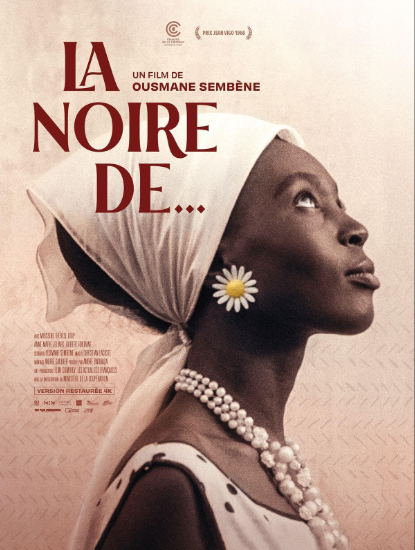
Was looking for movies that laid the groundwork for African cinema—the pioneers, the godfathers, the early voices in directing, acting, and storytelling—I stumbled on this classic: Straight out of Senegal, this film is directed by Ousmane Sembène, one of the most respected and influential figures in African cinema. Sembène isn’t just a director—he’s often called the father of African film. He also wrote the story himself, adapting it from his own short story. “Black Girl” (original French title: La Noire de…) was released in 1966 and is widely recognized as the first feature-length film to come out of sub-Saharan Africa. . This 59-minute black-and-white masterpiece is a Senegal-France co-production, , but make no mistake: this is an African story told from an African perspective, and that’s what makes it so powerful.
The Story: Diouana’s Tragic Journey
Set in the post-colonial era, the film takes place in the 1960s. The film follows Diouana, a young Senegalese woman who takes up a job as a maid for a French couple. At first, things seem hopeful. The madam is kind—giving her old clothes and shoes—and even promises her a trip to France. Diouana looks like someone who truly believed in the dream of France. To her, France represented a better life, a kind of perfection. She envisions a cosmopolitan lifestyle, continuing her work as a nanny for the couple’s children. Off topic, but this reminded me of an article I once read—about how some enslaved people were often given promises of a better life in France. I’m not even sure our ancestors who remained in the homeland of Africa ever imagined the slightest bit of what was happening across the ocean.
The Shift: When Kindness Turns to Cruelty. When Diouana arrives in France, everything changes. The madam becomes cold and controlling. Diouana is no longer just a nanny—she’s turned into a full-time domestic worker, always commanding Diouana, sometimes refusing to give her food despite her hard work. She couldn’t sleep when they were awake. Sometimes, no pay. Even going outside to explore Antibes was difficult. Poor girl had even lost contact with her family. It took serious effort for her mother to get her new address, sick and wondering why Diouana was no longer sending money home.
One Scene That Hit Me, One scene that truly got to me—or rather, the unfairness of it all—is when Diouana receives her mother’s letter. Because she cannot read, the master has to read her letter for her, and then ignorantly asks what she wants to write back home. What do you expect her to tell you? That all is well and the madam is treating her nicely? Of course, she couldn’t write her true feelings using the master’s hand. Poor girl had no confidant. This moment captures the utter powerlessness of Diouana’s situation—she can’t even communicate with her own family without white intermediaries filtering her words. That silence says everything.
The Ending: Money Can’t Buy Dignity; The French master tries to hand out money like it’s compensation—as if money can fix everything Diouana endured.But that moment exposes something deeper. Even though Diouana came for money and a better future, her dignity was never something that could be bought. Our cultures were never built purely around money. There’s pride. There’s humanity. And it’s honestly ignorant to think you can just throw money at suffering and walk away clean. And then there’s that final image—the boy following him, wearing the mask. That scene is powerful. It feels symbolic. Like guilt. Like history. Like something that refuses to be buried. And the way the man tries to escape it… says everything.
What I Learned About Ousmane Sembène and African Storytelling; I got to learn more about Sembène and his unique way of telling African stories at a time when the continent was trying to find its balance between post-slavery and colonialism. Such movies were a way to show that we could also dream big, have families who loved us, and that we can never be bought. Sembène’s storytelling is simple but powerful. Through Diouana’s experience, he explores: Colonial power dynamics, Exploitation of African labor, Identity and displacement, The illusion of the “better life” abroad.
I recommend this to everyone: For Africans who want to learn more about our continent’s cinematic heritage, For anyone interested in seeing where African cinema began, For film students studying postcolonial theory, neocolonial critique, or the history of world cinema, For classic movie lovers who appreciate slow-burn, character-driven drama. This isn’t just an old movie—it’s a foundation. A piece of history that helped shape what is now a booming African film industry.