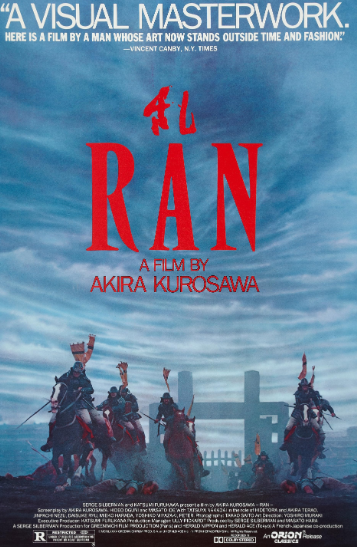
Let me tell you about Ran. This Japanese classic is hands down one of the best book-to-movie adaptations you will ever watch. And for my readers who know the books always set the bar high, imagine adapting a Shakespeare play and actually doing a good job. No, scratch that. An incredible job. Ran is based on King Lear by William Shakespeare. But director Akira Kurosawa took that story and made it entirely his own, transplanting it into 16th-century feudal Japan. And what came out the other side is nothing short of a masterpiece. Also, fun fact: it was the most expensive Japanese film ever made at the time, and you can see every bit of that budget on screen.
The Story: Chaos Comes for Everyone; Ran – which translates to “chaos” – tells the story of an old king, Lord Hidetora Ichimonji, who decides to divide his kingdom among his three sons. He banishes the youngest, Saburo, who speaks the truth about how disastrous this plan will be. Then the two older sons, Taro and Jiro, team up and betray him. And from there? Everything falls apart. Classic Shakespeare—but with Kurosawa’s vision, it becomes something else entirely. I really enjoyed watching this movie. It’s a combination of a book I have read and loved, good directing, fantastic acting, beautiful scenery, and the fact that it’s an old classic that still holds up perfectly today. I just had the best time watching it.
The Acting That Will Haunt You, I loved the acting of the king and Lady Kaede. Those two did absolute justice to their roles. The king, played by Tatsuya Nakadai, shines from beginning to end. Mostly from that scene when he loses everything in a burning castle, you can see that he will not recover. The silence when he sits through the storm, when he completely detaches from reality. Kudos to Mr. Nakadai. He shows you what absolute devastation looks like. You already know he’s not coming back from that mentally
And then there’s Lady Kaede, played by Mieko Harada. I know and saw that everyone appreciates the same scene as I – the confrontation between her and her husband’s brother. She goes from grieving wife to manipulator, then to the confession, then to the proposal. She’s a lunatic, revenge-driven force of nature. Let me say this: a woman doesn’t need to have a front seat to have influence and power. Ask Lady Kaede. She proves that point better than anyone.
Where the Budget Went (And Why It Matters). Later, finding out about its budget, I saw exactly where the money went. We’re talking hundreds of horses, thousands of background actors, incredible cameras, detailed makeup, massive buildings, authentic armor and costumes, and real locations. I mean, everything was authentic. No CGI was used. Real locations. One-take scenes that had to be perfect. The war scenes. The battle sequences. The blood, man. It all feels raw and controlled at the same time. This movie is a must-watch. The director, Akira Kurosawa, was already well respected in Japan and around the world. But after watching Ran, I immediately understood why he’s considered one of the greatest filmmakers who ever lived.
What Ran Shows Us: Ran shows you that even great empires can end because of war, envy, backstabbing, and past sins. Kurosawa doesn’t flinch from showing how one old man’s pride and foolishness can unleash chaos that destroys everything and everyone around him. It’s not just about kings and kingdoms—it’s about human nature. And that’s why it still feels relevant.
Final Thoughts – A True Classic; This movie has everything from a strong literary foundation (King Lear), masterful directing from Akira Kurosawa, fantastic acting, beautiful, large-scale cinematography, and finally, real, immersive battle sequences. I honestly just had a great time watching it—not in a light, fun way, but in that this is cinema kind of way. It’s a must-watch, especially if you love classic films, Shakespeare, or epic storytelling done right.
If you’ve ever doubted that a Shakespeare adaptation can truly work on screen, Ran will change your mind. Ohh, any adaptations you can recommend?