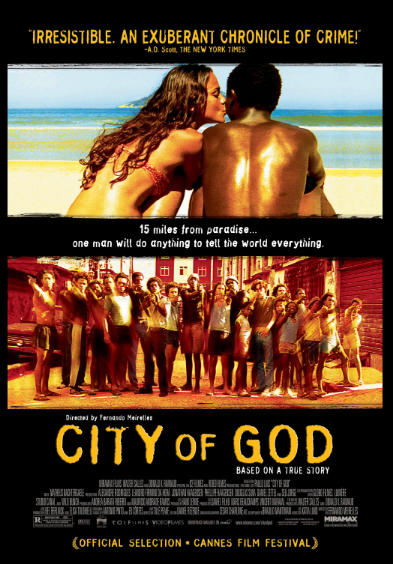
“I smoke, I snort, I’ve killed and robbed—I am a man.”
A city where what defines you as a man is crime. This Brazilian favela, born from good intentions, became a place where drugs, guns, rape, and chaos wrote every chapter. I remember watching this movie when I was young. I didn’t remember much else—only that I loved it and the title stuck. Rewatching it now, I know exactly why I loved it. And yes, I’ve had a nice taste in movies since childhood (not to blow my own horn).
City of God (2002), directed by Fernando Meirelles and Kátia Lund, is one of those films you just cannot forget. It draws you into the story so deeply that you don’t want to miss a single frame. Piece by piece, Rocket reveals the city he knows as home. And here’s the truth: the city itself is the villain. You can see that all these people are dragged to their worst selves by this place—and it won’t let them leave. Those who try to escape, like Goose and Knockout Ned, end up dead. Gets you thinking: is it really the City of God?
Rocket: The Storyteller on the Outside; We meet all the characters through Rocket’s eyes. But even though he’s the narrator, he always feels like an outsider in the lives of the people around him. I loved his relationship with his brother Goose. Even though they walked completely different paths, Goose never forced Rocket into the hood life. That quiet respect between them has stayed with me. (And I still wonder—what really happened to the third member of their trio? Did he actually end up in church?)
The City Lives On; What you have to understand is that this movie isn’t just Rocket’s story. It’s the city telling its story through Rocket. And even at the end, the city still lives—spawning a new generation of the runts after Benny, Carrot, Rocket, Li’l Zé, and the Trio are gone, The cycle never breaks. Throughout the movie, you watch an underdog like Rocket survive. He hates violence. His only goal for half the film is to lose his virginity—which he eventually does with an older news reporter, only to have a pretty mediocre experience. It’s awkward, funny, and painfully real.
Who I Pitied Most: Knockout Ned; The character I pitied the most was Knockout Ned. When we first meet him, he stands for peace and love. But the city pulls him in, reshapes him, and ultimately destroys him. His death feels inevitable—because in this world, what goes around truly comes around. But still… Ned’s fall hurts because he tried to be good.
The Child Actors Stole Everything; The people who shined brightest to me were the child actors. Every single one—whether playing the younger versions or the runts—steals the spotlight. You see kids whose futures are already mapped out, and they’re innocently rolling along toward violence like it’s just another game. That’s the real horror. Credit to director Fernando Meirelles and co-director Kátia Lund—this film runs over two hours, yet it has no filler. The pacing never slows down. It keeps you locked in from beginning to end.
A Question About the Photos; I still think about those photos Rocket took—the Runts killing Lil Z and the corrupt officers. What happened to them? We know Rocket is timid, not a fighter. Maybe he never released them. Maybe he was too soft-hearted, especially when it came to those kids. In the end, he chooses survival over truth. And Benny—people might call him “good,” but he wasn’t. He had been killing since he was young, just like Lil Z. The difference? Benny had a sense of balance, maybe even restraint, and was better at smiling. That’s not innocence. That’s just charm. Lil Z was pure chaos.
Final Thought; City of God was built with good intentions—a place for the “unwanted.” But it became something else entirely: a center of violence. With no real government intervention, things only spiral further out of control. And that’s what stays with you. This isn’t just a movie. It’s a story that keeps going—even after the camera stops rolling.