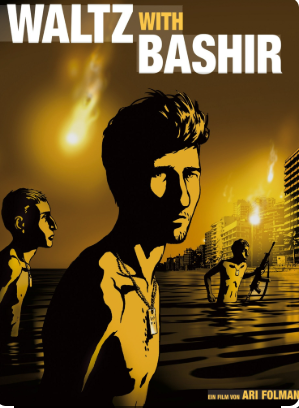
Now let me say this: I have never watched a movie from the bad guy’s point of view before. It was a new, deeply unsettling experience. Waltz with Bashir is an Israeli animated war documentary film directed by Ari Folman. It follows Folman, who served as a soldier during the 1982 Lebanon War, as he tries to recover memories he lost about the war and what happened during the Sabra and Shatila massacre.
For a while, I went along with it. At the beginning, Folman presents himself as a vet passing through something so traumatic he erased it from his mind. That seemed human and understandable. But halfway through the movie, something clicked for me. I thought maybe I had misjudged the angle. Surely, he wouldn’t have been on the wrong team, right?
I realized the storytellers in the documentary — the soldiers themselves — might actually be the villains in the story. And that realization hit hard. Then came the scene that stopped me cold. I had to pause the movie to do some research because I thought I must be wrong.
The Moment That Changed Everything. There is a scene where soldiers start randomly and ridiculously shooting at an old Mercedes-Benz car without caring who is inside. Later, they discover it was just a family. Thousands and thousands of bullets were fired because they were scared. Thousands and thousands of bullets, wasted on a car full of civilians. That’s when I paused the movie; I needed to check if I was misunderstanding something. My surprise was immense when, with a little research, I discovered the truth about the 1982 Lebanese War and, more specifically, the Sabra and Shatila massacre. I learnt more about the 1982 Lebanon War and especially the Sabra and Shatila massacre, which happened in Beirut between September 16 and 18, 1982. During those days, between about 1,300 and 3,500 civilians, mostly Palestinians and Lebanese Shiites, were killed in refugee camps by the Lebanese Christian militia known as the Phalangists (Lebanese Forces), with support from the Israeli military that controlled the area at the time.
Yeah… that changed how I saw the entire film.
What the Film Does Well, If this was meant to show a veteran facing PTSD and buried memories, then the film did that very accurately. As Folman searches for his memories, we meet his fellow vets, and each has their own story to tell. We meet people who wanted to prove themselves to society as real men, those forced into war by circumstances, and Folman himself, who was following in his father’s footsteps. You get to see the guilt they still live with as survivors, the paranoia they feel about having their kids’ pictures taken, and how they have adapted to their “new normal.” The film shows that being a soldier—whether from the victim’s army or the villain’s—leaves scars. War is never pretty. Since either side believes they have a reason to fight, the psychological damage is universal.
I sympathized with these vets, and I hated that I did; Because at the end of the day, these soldiers — trained professionals — were involved in events that led to a massacr And what do they tell us?, “We had no idea.” “We didn’t know what was going on in the camp.” “We told our direct commanders.”, They said this over dinner while the massacre was still going on. They literally saw the Phalangists take out civilians and didn’t suspect anything? Come on. They flew flares to light up the sky for the Phalangists, yet no one saw what was going on? Am I supposed to say, “Aww, poor guys, they didn’t know”? .Respect Where It’s Due: Ari Folman Didn’t Hide Anything
Respect Where It’s Due: Ari Folman Didn’t Hide Anything, One thing I have to respect the director/writer for is showing us what actually happened. There is no sugar-coating. The animation style is surreal and dreamlike, but the violence is stark. It doesn’t pretend the soldiers were heroes. And the ending… that ending hit me hard. The movie suddenly switches from animation to real archival footage of the aftermath of the massacre. Women crying over bodies, real victims, real consequences.
Nothing blurred. Nothing softened. The voices of those crying women are honestly going to stay with me for a while—the footage of children’s dead bodies, lots and lots of dead bodies.
Why the Film Was Controversial, I later discovered that the film was banned in several Arab countries, partly because critics felt it followed a “shoot and cry” narrative — where soldiers express guilt but still center their own emotions rather than the victims. And honestly, I understand why people would be angry about that. Because for many people in the region, this is not just history — it’s trauma that is still very real. In Lebanon, the film was officially banned, with critics saying it depicts a violent time in Lebanon’s history that many would rather not revisit through an Israeli lens, rightly so.
A Learning Experience for Me As a Christian myself, this film was also a learning curve.I didn’t know that there were Christian militias involved in major war crimes.The Phalangists, also known as the Lebanese Forces, were a powerful Christian militia formed by Bachir Gemayel, who had strong political and military influence in Lebanon at the time.And after Gemayel was assassinated in 1982, members of this militia carried out the massacre in Sabra and Shatila. That was something I genuinely did not know before watching this movie. So yes — I’m definitely going to educate myself more about the Phalangists and the history of Lebanon.
I recommend Waltz with Bashir to everyone. Not just people who like good movies, but people who want to learn something uncomfortable about history.
This film is part of the larger puzzle of the ongoing tensions between: Israel and Palestine, Palestine and Lebanon And the legacy of the Lebanese Civil War
It’s a solid adaptation with a storyline that will keep you glued to the screen, even as you shake your head in disbelief till the end.
This is a movie that respects the viewer enough to show the horror and the guilt. It’s not easy to watch, because sometimes the most important stories are the ones that make us uncomfortable. But it’s essential