“Do you know why you’re here?”
“yes”
“Why”
“I want to sue my parents.”
“Why do you want to sue your parents?”
“Because I was born.”
That’s the court conversation between a judge and a 12-year-old. There is something about this scene that will stick with you, something relatable, especially to people like me who have grown up in humble backgrounds. Not really reaching the point of suing our parents, but I’m sure at a certain time you have questioned your existence on earth, is it worth it? Like you struggle so much, sometimes financially, emotionally, mentally, the expectations in life, the falling and standing up again, and you just reach that breaking point.
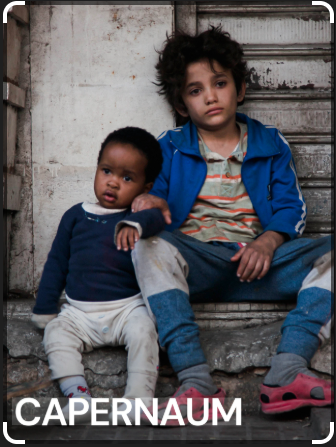
And that’s what makes this Lebanese movie memorable, it’s a documentary-like movie that you feel like you’re watching a documentary and a movie at the same time. It’s a story about Zain, a 12yr old boy who lives in poverty with his family in the slums of Beirut. Zain has one of the best onscreen sibling relationships you will ever find with his sister Sahal, but conflict breaks out when his parents marry her off after she gets her first period. Zain runs away, encountering the Ethiopian refugee Rahil and her son Yonas. A chain of events left Zain alone with Yonas, forcing a 12-yr-old to look after a 1-yr-old without any help.“Most art is made by adults. When a grown-up writes a novel or paints a picture about children, they don’t necessarily need actual children as part of the process. But when you’re making a film about children, unless it’s an animation, you need to take kids into the centre of the action. The child deforms the film in a good way. Makes it its own.” Mark Cousins. And this is what filmmaker Nadine Labaki gives us, a film about poverty and how it moulds a child, as told by a child. Labaki makes sure that everything we learn is told from a child’s perspective rather than a third party.
The movie tackles a lot of subjects I am familiar with at a personal level like child marriage, when Sahal is basically sold off to the landlord, street children, as Zain struggles to take care of Yonas, illegal immigration, the sad story of Rahil, refugees that fall victim to Aspro’s Sweden dream. It also aroses questions like the importance of birth control in the control of poverty. Kudos to the director Nadine Labaki for her extensive research and the decision to cast raw talents like Zain, played by Zain Al Rafeea, Sahal, played by Cedra Izzam, and Yonas played by Treasure Bakole, Rahil, played by Yordanos Shifera who give us untainted rawness that is so crucial to the sensitivity of the movie; all were actually cast off the streets. The fact that Rahil was arrested during the filming of the film and baby Yonas deported back to Kenya with her mother provides more authenticity and originality to the film especially the real-life struggles of refugees as mirrored in the film. You see, the beauty of Capernaum is that it leaves and takes something from you after watching it. You end up wanting to recommend it to as many people as you can.
So yes, I highly recommend Capernaum, you will be amazed by the acting of not only Zain but everyone aound him. I saw my own childhood in Zain’s struggles as a child born in a big poor family, in a world where girl children are more of an insurance to be married off, school is a luxury but somehow the society repects you based on how many children you have.